Customer Service
703.757.7313
If you require assistance with your on-line order or have questions, please contact us via: email or our customer service line 703.757.7313. Should you call outside of customer service hours or we are assisting another customer, please leave us a detailed message (full name, phone number) and we will address your inquiry within one business day.
Our representatives are available from 9:00AM to 5:00PM EST
Monday through Saturday.
PLEASE NOTE: Our retail store and on-line stores are two separate divisions. Internet merchandise is NOT AVAILABLE in our retail store. All Internet purchases must be returned by mail (See Return Policy). We cannot accept Internet merchandise returns via our retail store. Thank you for your understanding. If you have additional questions, please call our customer service number 703.757.7313.
General Jewelry Care
- Keep your fine jewelry items from contact with one another to avoid abrasion.
- Keep your jewelry looking new by cleaning it regularly. Soap and oils from fingerprints can significantly detract from the beauty of your diamonds and fine jewelry.
- Apply makeup and cosmetics prior to putting on your jewelry. Chemicals in these substances can often harm the look of your gold and damage pearls.
- Avoid wearing jewelry in swimming pools. Chlorine can react with metals causing color and structural damage.
- Fine jewelry items should not be worn while engaged in activities where they would be subject to any form of brushing or hard contact. A strong blow from the side could dislodge a gemstone from its mounting. If you decide to wear your jewelry while working in the kitchen, garden, or cleaning, please exercise caution.
- Cultured pearl necklaces should be strung with knots between each bead. Please keep all pearls away from hairspray, perfume, and cosmetics.
- It is recommended that all jewelry be inspected semi-annually or after any sharp blow to stones or mounting.
Jewelry Sizing Help
Ring 'Sizing'
- We charge $25 for each size that a ring has to increase or decrease. In most instances rings can be sized 2 sizes in either direction. Some of our rings won't be able to be sized due to the intricacy of their design, but we indicate this on the "details" page for that product. We don't have a standard ring size (some are 6 some are 7 depending on current inventory) but base sizes are indicated on product details page as well.
Bracelet and Necklace Sizing
Jewelry Buying Tips/Advice
- When buying diamonds, know the 4C's
- When considering a pearl purchase,
- Color. Look at both the surface and underlying colors. For white pearls the creamier the color the more value the pearl has. A soft rose undertone will add more value as this type of pearl is less common than solid white. Many colors, such as black pearls, will command an even higher price.
- Shape: The shapes of pearls are divided into three separate categories: symmetrical, spherical and baroque. Symmetrical pearls are the most common, less valuable than Spherical, but generally more expensive than baroque. Symmetrical pearls include button, oval and drop shaped specimens. Spherical pearls are judged by their uniform roundness. These are the pearls most often made into strand pearl necklaces
- Baroque pearls are any pearls that do not fall into the previous two categories. Baroque pearls are typically more irregularly shaped and are rarely of any uniform size. Most freshwater pearls are classified baroque.
- Size. Pearls are measured in millimeters; the larger the pearl is in size, the more expensive the pearl becomes.
- Orient and luster. This term pertains to the iridescent qualities and the intensity of light reflected from the surface of the pearl. The play of iridescent colors from the surface helps to determine the value of the pearl.
- Cleanliness. This is simply checking the pearl to determine how free from blemishes the surface is.
- When choosing a strand of pearls, the most important thing to look for is how well each pearl is matched to the others. Each pearl in the strand should have the same shape, color, size and luster. Any noticeable differences will decrease the value.
- Choosing Gemstones:
- Color is the important factor. But its not true that the darker the color, the better the stone. Atleast not correct every time: color can be too dark, like some sapphires that look more black than blue. Think grass green, not forest green. Fire engine red, not burgundy. The more bright and vivid the color, the better. In precise grading terms: clear, medium-tone, intense and saturated primary colors are the most preferred. Pure blue, not greenish blue. Pure red, not purplish red. Muted colors and colors between hues, which you might find very attractive, are usually less expensive. Look at the color in different kinds of light.
- The next most important factor affecting value is clarity: clear transparent gemstones with no Gemstone cut visible flaws are the most valued. There is no standardized grading system for clarity: it varies by gem variety. With colored gemstones, if the inclusion doesn’t show in the face up position, it generally doesn’t matter at all. (unlike diamonds which are graded upside-down at 10x magnification). Some varieties, notably emerald and red tourmaline, are very rare without inclusions of some kind so the price structure takes this into account. Pastel colored gemstones show inclusions more, so they generally detract more from the value for pale stones. In rare cases, inclusions can increase value. Special effects like the star in star sapphire and the eye in cat’s-eye chrysoberyl are caused by inclusions. Inclusions can also be a birthmark, proving that a gemstone is from a particular place. So "horse-tail" inclusions in demantoid garnet make it more valuable because they prove it came from Russia.
- Gemstones are sold by weight, not by size. Prices are calculated per carat, which is one-fifth of a gram. Some gems are denser than others so the same weight stone may be a different size! For example a one-carat emerald is a bigger than a one-carat ruby. Just like diamonds, the carat weight also affects the price: large gemstones are more rare, so the price per carat is higher. But practically, this doesn’t make much of a difference with common gems like amethyst, citrine and blue topaz. It really kicks in for ruby, emerald, sapphire, and demantoid garnet,tourmaline, spinel, and pink topaz.
In-Store Appointments
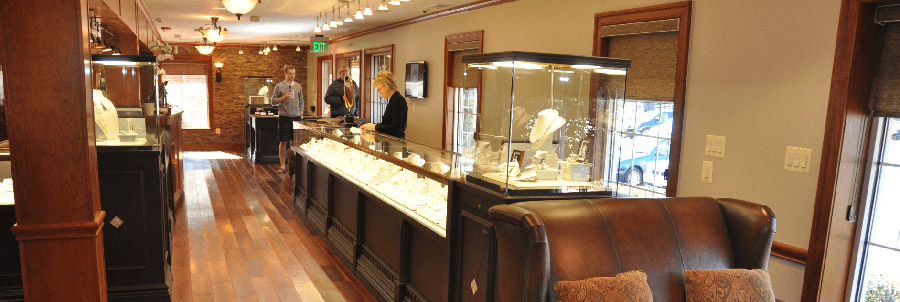
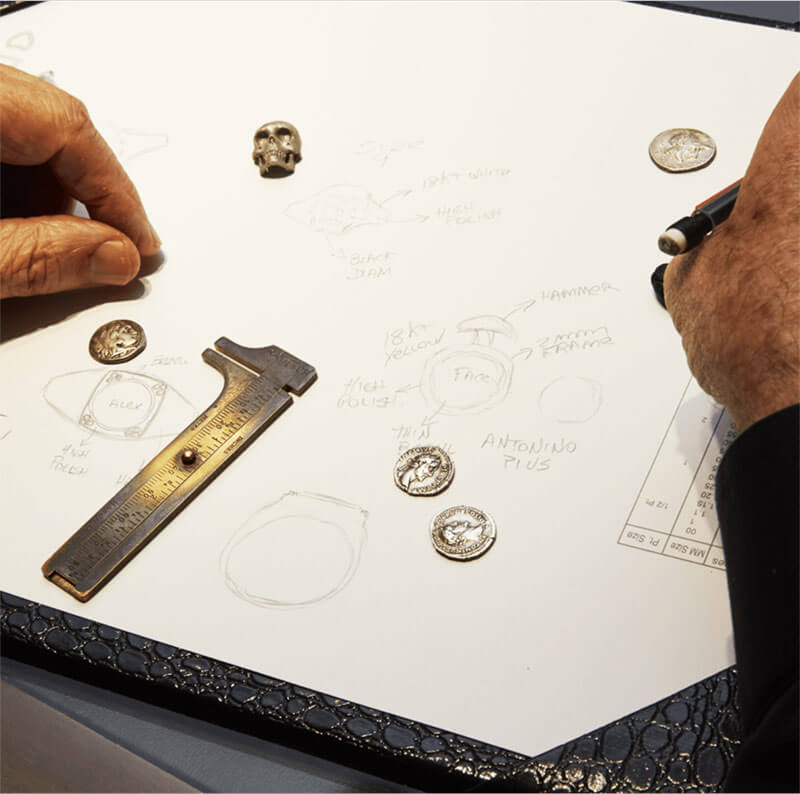
We welcome working with clients in person. If you would like a personal shopping experience or help realizing your own design for a special piece of jewelry, call us (703.759.4076) to schedule an in-store appointment.